

County Living Without Giving Up Convenience
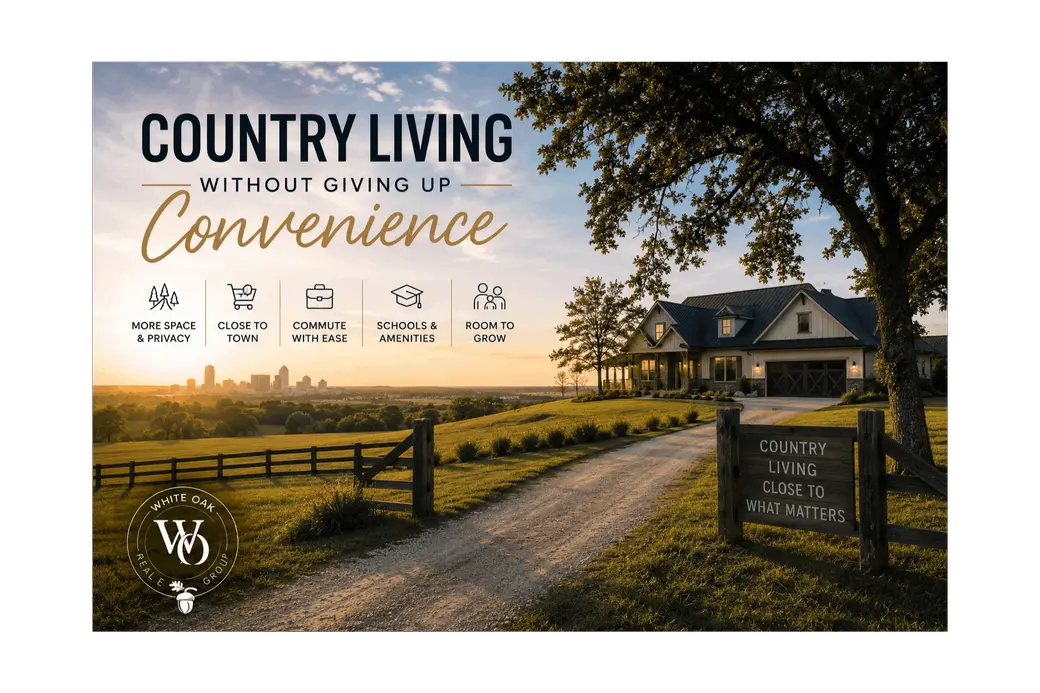
For a lot of Oklahoma buyers, moving to the country doesn't mean wanting to disappear into the middle of nowhere.
They want some land. More privacy. Fewer neighbors. Maybe a shop, a few animals, or enough room for the kids to run around.
But they still want to grab dinner in town, get the kids to school, make it to work without an hour-long commute, and have a grocery store reasonably close by.
That's why properties within about 20–30 minutes of town can be so appealing. They offer a middle ground between neighborhood living and truly remote rural property.
The key is figuring out what “country living” actually looks like for your family before you start searching.
Start With the Lifestyle You Want
It's easy to begin a rural property search by deciding you want five, ten, or twenty acres.
We think there's a better place to start.
What do you actually want the land to do for you?
Maybe you want enough room for a large shop and equipment. Maybe it's horses, a garden, chickens, or a small pond. You might want woods behind the house where the kids can explore or enough separation that you can't see your neighbor from the back porch.
Those answers can help determine how much acreage you actually need.
Sometimes five well-laid-out acres will accomplish more for a buyer than twenty acres that don't fit their lifestyle.
Decide How Far From Town You Really Want to Be
There's a big difference between wanting to “live in the country” and wanting to live remotely.
Think about your normal week.
If you're driving into town twice a day for work, school, sports, and activities, an extra 15 minutes each direction adds up quickly.
For other buyers, that additional drive is exactly what they're looking for. The further they get from town, the more likely they may be to find larger acreage, greater privacy, and fewer surrounding developments.
There's no magic number.
For some buyers, 15 minutes outside town feels rural enough. Others don't start feeling at home until they're 30 or 40 minutes out.
The Road Matters More Than the Mileage
When looking at rural property, don't judge convenience by mileage alone.
Ten miles down a highway is very different from ten miles of narrow county roads and gravel.
Drive the route you would actually take to work or school. Pay attention to pavement, traffic, bridges, low-water areas, and the condition of the county roads.
And remember that the road you're seeing on a beautiful Saturday afternoon may look a little different after three straight days of Oklahoma rain.
Convenience Looks Different in the Country
Living outside town usually means trading some convenience for space and privacy.
Instead of running five minutes to the store, you may plan grocery trips ahead. Food delivery may be limited. Your favorite coffee shop probably isn't around the corner.
On the other hand, your backyard might be ten acres instead of a tenth of an acre.
For many people, that's a trade they'll gladly make.
The goal isn't to recreate city convenience in the country. It's to decide which conveniences matter enough that you still want them reasonably close.
Internet and Cell Service Can Change the Equation
This has become especially important as more people work from home.
A beautiful rural home 25 minutes from town may sound perfect until you discover that reliable high-speed internet isn't available.
Internet options have improved considerably in rural areas, but availability can still vary from one road to another.
If you work remotely, stream frequently, homeschool, or have several people using the internet at once, connectivity should be part of your property search—not something you investigate after moving in.
The same goes for cell service. Pull out your phone while you're touring the property and see what kind of signal you actually have.
More Land Usually Means More Responsibility
Acreage gives you freedom, but it also gives you something to take care of.
A bigger yard may require a tractor instead of a lawn mower. Gravel driveways need maintenance. Trees fall. Fences need repairs. Pastures need mowing, grazing, or management.
For many landowners, that's part of the enjoyment.
There's something satisfying about improving and taking care of your own property. But first-time acreage buyers should understand that moving from a subdivision lot to ten acres changes more than their address.
Think About Where the Area Is Going
One thing we encourage buyers to consider is not just what an area looks like today, but what it could look like ten years from now.
Communities surrounding Tulsa and other growing Oklahoma cities continue to expand.
That quiet road outside town could eventually see additional homes, subdivisions, commercial development, or increased traffic.
On the other hand, buying in the path of responsible growth can sometimes be beneficial to long-term property values.
Understanding surrounding land use and the direction an area is developing can help you decide whether a property fits both your current lifestyle and your long-term plans.
You May Not Need as Much Acreage as You Think
It's easy to start a search saying, “I want at least 20 acres.”
But what are you planning to do with those 20 acres?
If your goal is privacy, a shop, a garden, and enough room to enjoy the outdoors, a well-positioned five- or ten-acre property may give you everything you're looking for.
Conversely, someone wanting cattle, serious hunting opportunities, or additional agricultural uses may quickly realize that ten acres isn't enough.
Instead of choosing an acreage number first, determine what you want from the property and work backward.
Finding the Best of Both Worlds
For the right buyer, living outside town offers something that's increasingly hard to find: room to breathe without giving up connection to the community around you.
You can have land, privacy, a shop, animals, or a little more space between neighbors—and still make it to work, school, dinner, or the grocery store without planning an entire day around the trip.
That's the sweet spot many Oklahoma buyers are searching for.
At White Oak Real Estate Group, we help buyers look beyond bedrooms, bathrooms, and acreage numbers. We want to understand how you plan to live on the property so we can help you find a place that actually fits.
Whether that's five acres fifteen minutes from town or forty acres at the end of a gravel road, the right property is the one that fits the life you're trying to build.
White Oak Real Estate Group
Rooted in Faith. Built on Relationships.
Your Source for All Things Real Estate.